
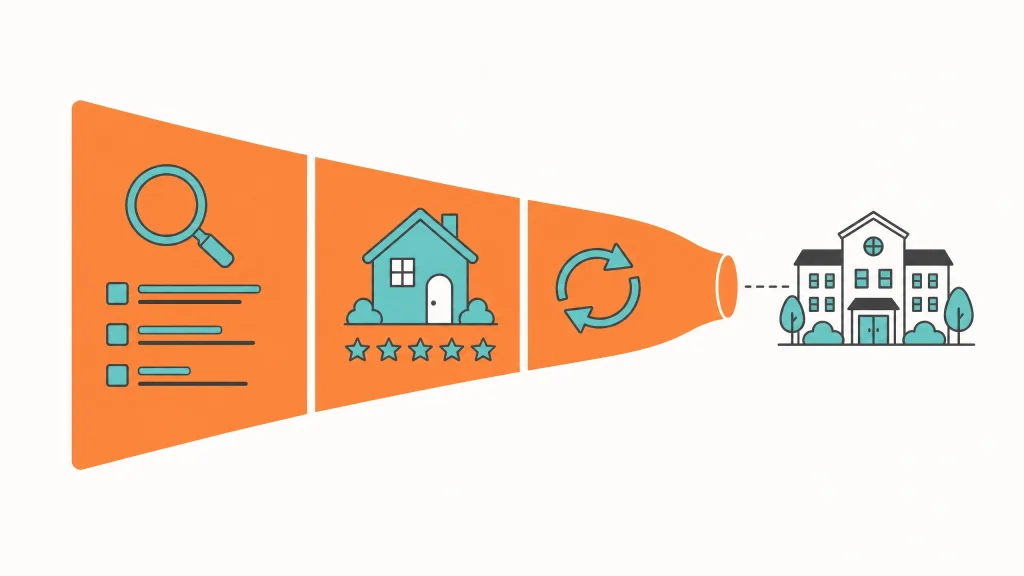
Senior living marketing is the work of getting found by families searching for care, getting chosen once they find you, and getting them to move in before a competitor answers the phone first. Most communities are losing at step one.
Across the 100-plus communities we have audited, roughly 85 percent had listing information that disagreed across directories. Families never saw the tour. That number is the reason this guide exists.
We run a standard digital presence audit at Pathly CRM: a scan of roughly 40 directories to see what information is publicly attached to a business, followed by a domain audit covering authority, organic traffic, ranking keywords, and backlinks. It takes about twenty minutes. It almost always finds the same five problems, in the same order, at communities that believe their marketing is fine. This guide covers the full funnel: get found, get chosen, come back. It is written for executive directors, sales and marketing directors, and owner-operators who carry an occupancy number and do not have time for theory.
Why is marketing for senior living different from other local marketing?
Three things make it harder than marketing a restaurant or a dentist.
The decision is emotional and urgent. A daughter searching at 11pm after her father’s second fall is not comparison shopping over six weeks. She is looking for someone who will pick up.
The buyer is rarely the resident. Adult children research, tour, and often pay. Your content has to speak to a 58-year-old in Denver about a parent in Aurora.
The purchase is enormous. The national median cost of assisted living reached $6,200 per month, or $74,400 a year, up 5 percent year over year. At an average length of stay, a single move-in is a six-figure relationship. That math changes what a lead is worth and how fast you should respond to one.
Occupancy pressure is easing industry-wide, which cuts both ways. Senior housing occupancy climbed to 89.9 percent in the second quarter of 2026, the twentieth straight quarter of demand outpacing new supply. Strong national numbers do not fill your building. They mean the communities winning locally are winning decisively, and the ones with broken digital presence are absorbing the losses quietly.
What does a senior living marketing strategy actually look like?
Three stages. Most communities invest in the wrong one.
- Get found. Directory listings, Google Business Profile, local SEO, and now AI answers. This is where families start and where most communities are invisible.
- Get chosen. Your website, your reviews, your response speed, your tour booking experience. This is where families decide between you and the community four miles away.
- Come back. Follow-up on inquiries that did not convert, nurture for families who toured and went home to think, and reactivation of old leads. This is the cheapest occupancy in the building and almost nobody does it.
The order matters. Redesigning a website when your address is wrong on 40 directories is spending money at stage two to fix a stage one problem.
Stage one: how do families find senior living communities in 2026?
They search. Then they ask AI. Then they call the top two or three results.
Your listings are probably wrong
This is the single most common finding in our directory scans, and it is not close. Roughly 85 percent of the communities we have audited had inconsistent name, address, phone, or suite information across at least two directories.
The usual causes are boring. A suite number that appears on Google but not on Caring.com. A phone number that still routes to a line the community stopped using in 2022. A community that rebranded and updated its website but not the 40 other places its old name lives.
Search engines treat consistency as a trust signal. When your data conflicts, you rank lower. Worse, a family calls the wrong number and concludes you are closed. Fix listings before you spend a dollar on anything else. It is the cheapest lift in senior living marketing and it compounds into everything downstream.

Your Google Business Profile is set-and-forgotten
Among the businesses we have talked to that do have a Google Business Profile, roughly 80 percent set it up once and never touched it again. No posting, no review replies, no photo updates, no service or category maintenance.
Google reads activity as evidence a business is real and operating. A dormant profile ranks below an active one in the local pack, and the local pack is where the majority of “assisted living near me” clicks go.
Families are asking AI, and you are not in the answer
Over 90 percent of the communities we have audited did not surface when we asked AI assistants a local question like “best assisted living in [city].” Some of that is a hard problem. Much of it is not: a meaningful share of those communities have no website or no Google Business Profile at all, which means there is nothing for an AI system to cite.
This is the newest and least-contested opportunity in senior living marketing. AI answer engines pull from structured, consistent, well-cited sources. Communities that fix listings, maintain a profile, and publish content that directly answers family questions get cited. Communities that do not are absent from a channel their competitors have not noticed yet either. We wrote more on this in our guide to generative engine optimization and on how AI search is changing senior living discovery.
The 10-point get-found audit
- Search your community name plus your city. Does your Google Business Profile appear with correct hours, phone, and address?
- Check your name, address, and phone on Google, Caring.com, A Place for Mom, SeniorAdvisor, and Yelp. Do all five match exactly, including suite number?
- Call the phone number listed on each. Does it reach your sales line?
- Is your Google Business Profile category set to the most specific option available, not just “nursing home”?
- How many photos are on your profile, and when was the most recent one added?
- When did you last publish a Google post?
- Search “assisted living in [your city].” Are you in the local three-pack? On page one?
- Ask ChatGPT or Google’s AI overview for the best assisted living in your city. Are you named?
- Does your website load in under three seconds on a phone?
- Does your homepage state your city and the care levels you offer in text a search engine can read, not only in an image?
Anything you fail here is costing you tours right now. Our senior living SEO guide goes deeper on the local search mechanics.
Stage two: how do you get chosen once a family finds you?
Being found gets you into consideration. Three things decide whether you get the tour.
Reviews decide tours
Most of the communities we have audited have fewer than 50 Google reviews. That is a low bar, and it means review volume is still a competitive advantage in this industry rather than table stakes.
Families read reviews to answer one question: will my mother be treated well when I am not there. They weight recent reviews heavily and they read the negative ones first.
What works
- Ask at the moment of highest satisfaction. After a successful move-in, after a family event, after a care plan meeting that went well.
- Ask by text, not by email. Response rates are not comparable.
- Reply to every review, positive and negative, within 48 hours.
- On negative reviews, respond publicly with empathy and move the specifics to a private channel. Never discuss a resident’s care in a public reply.
Review velocity, meaning new reviews arriving steadily over time, matters more than total count. Ten reviews in the last six months beats sixty reviews from 2021. We cover the full system in senior living reputation management.
Your website probably does not let families book
Roughly 90 percent of the communities we have audited had no clear tour booking or scheduling path on their site. The family’s only option was to call during business hours or fill out a form.
A conversion-ready senior living website has a tour booking button visible without scrolling on mobile, real-time availability rather than a “request a callback” form, pricing transparency even as a starting range, care level pages that match how families search rather than how your org chart is structured, and photos of actual residents and staff rather than stock imagery.
See 12 senior living website designs that convert for teardowns of what this looks like in practice.
Nobody knows where the forms go
Roughly 65 percent of the operators we have talked to could not say where their website inquiry forms actually deliver. Someone set it up years ago, that person left, the notification email points at a departed employee’s inbox, and the leads have been going nowhere ever since.
This is the most expensive problem in the article and it takes ten minutes to check. Fill out your own form right now. Use a real email address you control. See if anyone from your team responds, and time how long it takes.
If a lead sits longer than five minutes, treat it as lost. Speed-to-lead is the most reliable predictor of whether an inquiry becomes a tour in this industry, and families in crisis mode are contacting three communities in the same sitting. First response usually wins.
Stage three: what happens to the families who do not convert?
Most communities do nothing, which is why this is the cheapest occupancy available.
A family that toured and went home to think is not a lost lead. They are a lead on a timeline you do not control. The trigger event, another fall, a hospital discharge, a caregiver burning out, will come. The question is whether you are in their inbox when it does.
A working follow-up system
- Immediate text and email confirmation on every inquiry, automated.
- Human call attempt within five minutes during business hours.
- A structured sequence over the first two weeks: tour recap, answers to the questions they actually asked, a resident story relevant to their situation.
- Monthly light-touch nurture after that, for at least six months.
- A reactivation campaign twice a year to every non-converted inquiry in your database.
This is CRM work, not marketing work, and it is where the senior living sales process either holds or leaks.
How much should a community spend on senior living marketing?
The honest answer is that spend matters less than sequence.
We have seen communities spend heavily on advertising while their listings were wrong and their forms were broken. That is paying to send families to a broken experience. The ad spend amplifies the leak.
- Fix the foundation. Listings, Google Business Profile, review system. Weeks one through four.
- Fix the conversion path. Booking, form routing, speed-to-lead. Weeks four through eight.
- Build the content and GEO layer. Pages that answer the questions families ask, structured so AI engines can cite them. Ongoing.
- Then, and only then, consider paid amplification.
At Pathly CRM we do not run ad spend at all. Growth comes from SEO and GEO, which is a slower start and a durable finish. Our packages are structured to follow that sequence: Get Found covers listings, Google Business Profile, local SEO, GEO, and analytics. Get Chosen adds the conversion website, booking, AI chat, CRM, reviews, and follow-up. Done-For-You adds social, email, content, automation buildout, and a dedicated account manager.
The reason we bundle senior living marketing services rather than sell tools is that these systems only work connected. A booking tool that does not write to the CRM creates the exact manual-reconciliation problem described above. One growth partner, multiple systems, is not a slogan. It is a response to what we find in nearly every audit.
What should you do in your first 90 days?
| Window | Focus | Specific actions | How you know it worked |
|---|---|---|---|
| Days 1 to 30 | Get found | Audit and correct all directory listings. Claim and complete Google Business Profile. Fix form routing. | NAP matches across all major directories. Test form reaches a monitored inbox. |
| Days 31 to 60 | Get chosen | Launch review request system. Add visible tour booking. Publish pricing range. Set five-minute response standard. | New reviews arriving weekly. Bookings happening without a phone call. |
| Days 61 to 90 | Come back | Build follow-up sequences. Reactivate dormant inquiries. Start publishing family-question content. | Measurable tours from leads older than 30 days. |

Run it in that order. Each stage makes the next one work harder.
The operator’s read on all of this
I spent years on the community side, carrying occupancy goals and running weekly sales meetings against a 150-point goal model. The thing that surprised me most when I started auditing communities from the outside was how rarely the problem was effort.
Sales directors are working hard. They are touring, following up, hosting events, and building referral relationships. The leaks are almost never in the human effort. They are in the plumbing: a wrong phone number on a directory nobody checks, a form pointing at a dead inbox, a booking tool that does not talk to the CRM, an AI assistant that has never heard of the community. That is fixable work, and it is unglamorous, and it moves census.
Frequently asked questions
How long does senior living marketing take to show results?
Listing corrections and Google Business Profile improvements can move local rankings within four to eight weeks. Review velocity shows up in tour volume within a quarter. Content and GEO work is a six to twelve month horizon. Anyone promising faster is selling ad spend, which stops working the day you stop paying.
What is the difference between SEO and GEO for senior living?
SEO gets you ranked in a list of blue links. GEO, or generative engine optimization, gets you cited inside an AI-generated answer where there is no list. Families increasingly get one recommendation instead of ten options, which raises the stakes on being the cited source.
Do we need to advertise on A Place for Mom or Caring.com?
They generate volume, and they charge a substantial percentage of first month’s rent or a flat referral fee per move-in. They are a legitimate channel. The strategic problem is that they own the family relationship and you rent it. Communities that build direct discovery alongside referral partnerships pay less per move-in over time and are less exposed when a partner changes terms.
How many Google reviews does a senior living community need?
There is no threshold number. What matters is being visibly ahead of the communities you compete with in your city and having recent reviews. Since most communities we audit sit under 50 total reviews, a community adding two or three a month pulls ahead quickly.
Who should own marketing at a single community?
Somebody with authority to fix things, which usually means the executive director or a sales and marketing director with budget. The failure pattern is assigning it to whoever has the most availability, because the work requires decisions about spend and vendor access, not just execution time.
Book a Free Digital Presence Audit
A scan of roughly 40 directories, a domain and visibility check, and a plain report of what a family finds when they search for you tonight. No pitch. Just what we find.